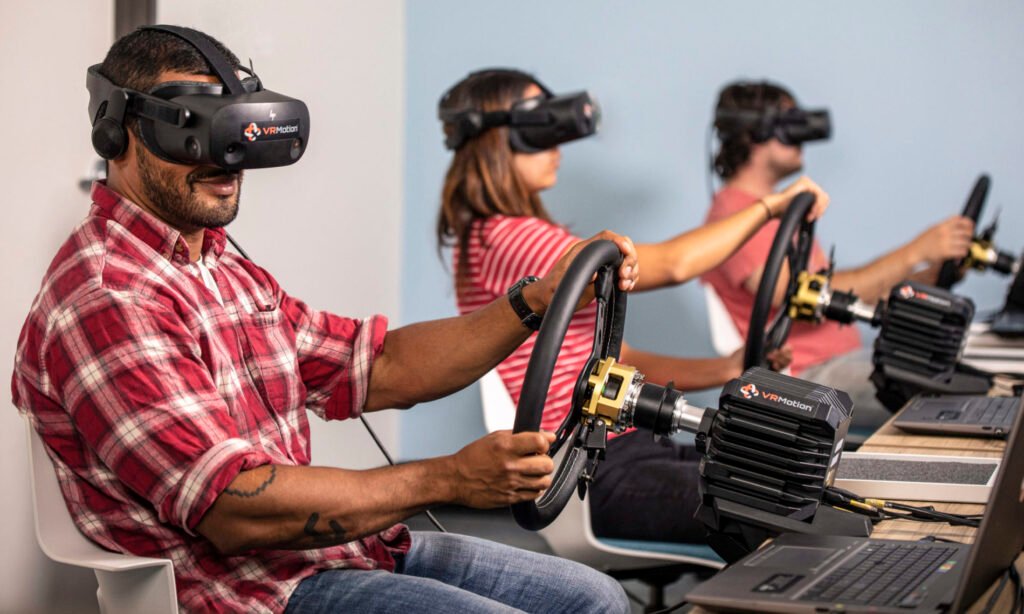

Virtual reality has moved well beyond the gaming console. Today it is changing how people build skills, rehearse high-pressure tasks, and prepare for the demands of real-world work. Across a growing number of industries, VR training simulators offer immersive, low-risk, and economical learning experiences that traditional classroom methods struggle to match. Hence, it has become fairly common to see the use of portable VR training simulator for law enforcement training.
How VR training simulators are reshaping the way people learn and perform
Modern policing is more complicated than ever. Officers may be called to respond to an active shooter one hour and to a person in the middle of a mental health crisis the next. These situations are unpredictable, emotionally charged, and extremely difficult to recreate in a standard training room. As a result, many agencies are exploring VR as a practical way to sharpen the judgment, communication, and de-escalation skills officers depend on when seconds matter.
A portable VR training simulator for law enforcement can create a computer-generated environment in which a person can rehearse real-world tasks as though they were actually there. Once a trainee puts on a headset, they step into a simulated scenario that closely mirrors real conditions. They can look around, make choices, and respond to events as they unfold.
The purpose is straightforward: help people develop stronger skills, make better decisions, and gain confidence, all without facing the consequences that a genuine mistake would carry. A misstep in a simulation becomes a lesson rather than a liability.
Here are some of the key benefits of VR-based training:
- A Safe Space to Practice: Safety is arguably the most compelling advantage of VR based training. Tasks that are hazardous, expensive to get wrong, or simply too complex for trainees can be practiced repeatedly in a virtual setting. Trainees can fail, reset, and try again with no harm to themselves, to others, or to costly equipment.
- Stronger Memory and Understanding: Learning by doing tends to stick better than learning by listening. Because VR places the learner inside the experience, concepts are tied to actions and surroundings, which helps knowledge become second nature.
- Long-Term Cost Efficiency: It is true that building a VR training program can require a significant upfront investment in hardware, software, and content. Over time, however, the numbers often shift in the organization’s favor. A portable VR training simulator can cut down on travel, reduce the need for physical training facilities and specialized equipment, and lower the ongoing cost of instructors. A single well-designed simulation can be reused thousands of times.
- Training That Scales Easily: Traditional training often requires bringing people to a single location, scheduling instructors, and setting up physical spaces. VR removes many of those barriers. A law enforcement agency can train large numbers of people at once, even when they are spread across different cities or regions, and every participant receives the same consistent experience.
Overall. VR training simulators are making learning safer, more engaging, and far more effective.